What Treatment Is Best for Varicose Veins? How Dr. Prevosti Chooses a Treatment Plan
Before you get to the question of which procedure fits your veins, there is a more basic one worth settling first: do your varicose veins need treatment at all? Some are purely cosmetic, while others signal a progressive circulatory problem. Dr. Prevosti's blog on whether varicose veins are dangerous or just cosmetic walks through the warning signs that separate the two, and it is the right starting point if you are still weighing whether to come in.
First, let's go over nomenclature. Varicose veins are, by definition, bulging veins that are 3 mm or greater in diameter. Visible thin veins less than 1 mm in diameter are spider veins. In medical terminology, they are called telangiectasia. Visible bluish or greenish veins that are between 1 mm and 3 mm are called reticular veins.
If you already know your varicose veins need attention, the next question is how they will be treated. Patients are often surprised to learn that the bulging veins they can see are usually not the main target. The real problem tends to sit deeper, in veins you cannot see, and Dr. Louis Prevosti offers minimally invasive treatment options built to reach them first.
The Veins That Matter Are Often the Ones You Can't See
Varicose veins form when the one-way valves inside your leg veins weaken, letting blood flow backward and pool under pressure, a condition called chronic venous insufficiency. The bulges at the surface are frequently downstream from a larger truncal vein (saphenous vein) or tributary vein that is failing beneath the skin. Proper treatment requires addressing the abnormal saphenous vein as well as the visible bulging vein.
This is like a plumber closing off the main water valve before working on a bad section of pipe. Close the failing saphenous vein first to relieve the back pressure, then eliminate the bulging veins at the surface. The difference is that the abnormal saphenous vein remains permanently closed. The body immediately shunts the blood to other veins, like the femoral vein, that efficiently transport blood out of the leg.
That two-step logic is the key to understanding varicose vein treatment. Dr. Prevosti offers a full range of options, and rather than a single menu to pick from, they divide cleanly into two jobs: closing the deeper saphenous vein, then removing or collapsing the surface veins it was feeding. Here, we cover the options for each step and how Dr. Prevosti decides among them.
Step One: Closing the Failing Saphenous Vein
Three of Dr. Prevosti's procedures share the same core strategy: close the faulty saphenous vein from the inside to relieve the back pressure on the varicose vein. All three are performed in the office under local anesthesia.
What separates them is how they seal the vein and the anatomy each one suits best.
Thermal: Radiofrequency Ablation (RFA)
Radiofrequency ablation, or RFA, is the thermal option and Dr. Prevosti's preferred method for treating saphenous vein insufficiency, the large trunk veins that most often drive varicose veins. He threads a thin catheter into the vein and delivers precisely controlled radiofrequency energy, heating the vein wall to roughly 120°C (248°F) so the collagen contracts and the vein collapses. He uses the ClosureFast system, which adjusts its energy automatically for uniform closure, and numbs the vein with tumescent anesthesia so you feel no heat. In Dr. Prevosti’s hands, RFA success rates exceed 95%.
RFA works beautifully on a straight, accessible trunk vein. That strength is also its limit. A catheter needs a reasonably direct path, so a significantly twisted vein is harder to treat this way.
Thermal: Endovenous Laser Ablation (EVLA)
Endovenous laser ablation, or EVLA, is also a heat-based closure, but the energy comes from a thin laser fiber rather than a radiofrequency catheter. Dr. Prevosti inserts the fiber into the vein under ultrasound guidance and slowly withdraws it, delivering controlled laser energy that heats the vein wall, shrinks it and seals it shut. As with RFA, tumescent anesthesia surrounds the vein to keep you comfortable and protect the surrounding tissue.
Where EVLA earns its place is precision on shorter, trickier vein segments. Dr. Prevosti reaches for it on targeted sections rather than long straight trunks: perforator veins that connect the superficial and deep systems, anterior accessory saphenous veins with their awkward anatomy and short saphenous segments in patients who have had prior treatment. The laser's focused energy delivery handles these configurations well.
Adhesive: VenaSeal™
VenaSeal takes closure off the heat spectrum entirely. Instead of thermal energy, Dr. Prevosti uses a medical-grade adhesive (cyanoacrylate) delivered in small amounts through a thin catheter at points along the vein. He applies brief pressure so the vein walls bond together, and the sealed vein stops the backward flow while blood reroutes through healthy vessels.
Because heat is not involved, VenaSeal carries no risk of the nerve irritation or skin burns that can rarely accompany thermal methods, and it does not require tumescent anesthesia, just a small amount of local anesthetic at the access site. It also often eliminates the need for compression stockings afterward. That combination makes it a strong fit for patients who cannot tolerate compression well or who prefer to avoid heat-based treatment. VenaSeal works on the great and small saphenous veins and certain tributary veins.
Comparing Saphenous Vein Treatments
Step Two: Eliminating the Bulging Varicose Veins
Once the culprit saphenous vein is treated, attention can be placed on the varicose vein at the surface. These are the ropey, visible veins that prompted most patients to come in. Dr. Prevosti uses three methods here, and they are frequently combined rather than chosen against one another, depending on the size and pattern of the veins involved.
Removal: Ambulatory Microphlebectomy
For large, bulging varicose veins sitting close to the surface, Dr. Prevosti often removes the vein directly. Ambulatory microphlebectomy uses tiny access sites, roughly 2 to 3 mm, through which he grasps and extracts the problem vein segments with fine surgical hooks. The procedure is done with local anesthesia, and the access sites typically need no stitches and heal on their own.
Because the vein is physically removed rather than sealed, patients see immediate improvement in both appearance and comfort, and the approach carries a lower risk of the brownish skin staining that can follow injecting a large vein. The technique demands real surgical skill, which is why many vein clinics do not offer it. Dr. Prevosti's years working with delicate cardiac vessels as a heart surgeon inform the precise, gentle technique it requires.
Foam: Varithena®
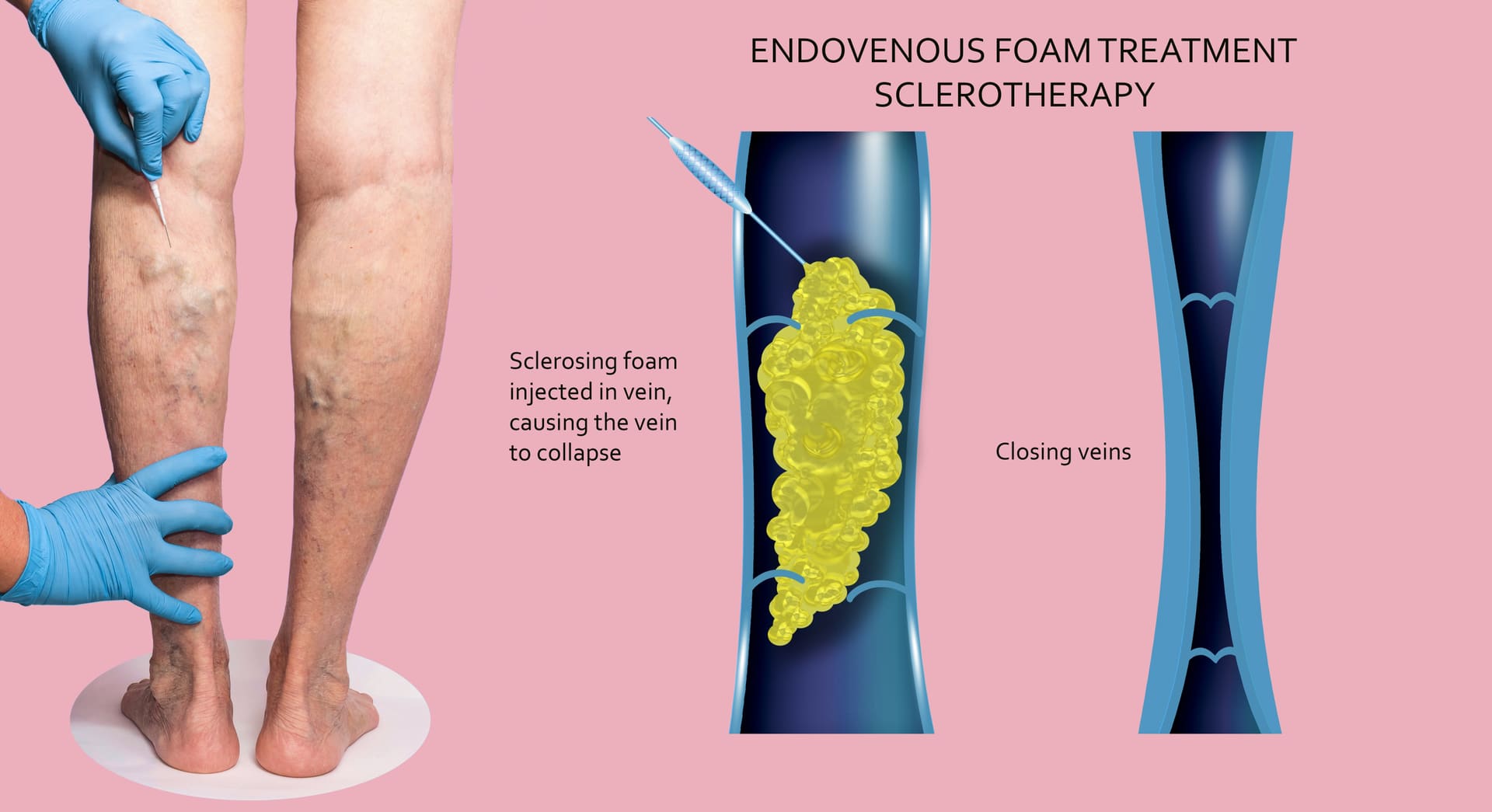
Varithena is a polidocanol microfoam that arrives in a standardized, FDA-approved canister rather than being mixed by hand. Dr. Prevosti injects the foam, which displaces the blood, coats the vein wall and closes the vein chemically. Because foam flows where a rigid catheter cannot, it reaches winding and branching veins that thermal ablation struggles with. The bubbles are small and uniform, which provide consistent coverage and allow it to treat larger and more tortuous veins effectively. The FDA caps a single session at 15 milliliters, so patients with extensive disease may need more than one visit.
Foam: Ultrasound-Guided Foam Sclerotherapy
With ultrasound-guided foam sclerotherapy, Dr. Prevosti prepares the foam himself by mixing Asclera (polidocanol) with gas, then injects it under real-time ultrasound so he can track it filling the vein. The foam damages the cells lining the vein wall (the endothelium) and leads to the vein closing down. This approach shines on the complex vein networks: tributary veins, reticular veins and the connecting vessels that other treatments cannot address. It is also a workhorse for recurrence, when veins reopen or new ones surface after earlier treatment.
Comparing Varicose Vein Treatments
Why This Is a Decision, Not a Menu
Reading tables, you might try to slot yourself into a column. In practice, that is not how good vein care works, and it is not how Dr. Prevosti approaches it. The choice depends on the map of your venous system, which only a diagnostic venous duplex ultrasound can produce. The scan maps out the veins and determines which are functioning normally and which are not, and that picture drives everything that follows.
Just as often, the answer is not one procedure but a sequence, which is the whole point of the two-step approach. Dr. Prevosti frequently closes a diseased saphenous vein first, then treats the remaining bulging veins and tributaries, because eliminating venous insufficiency thoroughly, rather than partially, reduces the chance of recurrence. His years handling delicate cardiac vessels as a heart surgeon inform the precision behind each of these techniques, and his experience also lets him recognize when leg symptoms point to a cause outside the veins altogether.
"Patients sometimes ask for a specific treatment by name before I have looked at their ultrasound," says Dr. Prevosti. "I understand the instinct, but the imaging has to come first. The venous anatomy helps me identify which tool it needs, and matching the technique to the anatomy is what produces a durable result."
Get a Clear Recommendation in Canton, GA
You do not need to arrive knowing which procedure you need. Sorting that out is the point of the evaluation. Dr. Prevosti personally performs every ultrasound interpretation and every treatment at Prevosti Vein Center, so the person reading your anatomy is the same person treating it.
If you are ready to find out which approach is right for your veins, contact Prevosti Vein Center to schedule your consultation.
Take Back Your Comfort and Confidence With Prevosti Vein Center
Every patient at Prevosti Vein Center receives personal attention from Dr. Prevosti, a vein specialist with decades of experience in cardiovascular surgery. At Prevosti Vein Center, you will have access to the caliber of diagnostic and treatment approaches only available from a dedicated specialist.
Dr. Prevosti employs a compassionate and patient-centered approach that can reduce your symptoms and improve your comfort and daily activity level. His commitment to excellence in vein care has helped thousands of patients regain the confidence and freedom they need to pursue active lifestyles without the limitations of vein disorders.
Contact Prevosti Vein Center today to schedule an evaluation and discover how an experienced vein specialist can improve your quality of life.
